Wednesday, June 28, 2017

DarazKaymu announces Mobile Week

Kathmandu, June 27: DarazKaymu has announced ‘Mobile Week 2017’ at its online shopping platform from July 3 to 7.
DarazKaymu is one of the leading online shopping platforms in South Asia with businesses in Pakistan, Bangladesh, Srilanka, Myanmar and Nepal.
“We have announced the mobile week so that our customers can get the best rates on mobiles phones and accessories. Its online mobile and accessories sale event that includes various mobile brands as well as smart watches, headphones, earphones etc.,” said Rajeev Amatya, managing director of the company.

According to the company, DarazKaymu is an online platform that connects buyers and sellers in a safe and convenient way.

Tuesday, June 27, 2017

Deprived sector lending reaches Rs. 100 bn

Kathmandu, June 25:
Executive director of the Nepal Rastra Bank (NRB) Nara Bahadur Thapa Sunday said that the deprived sector lending has reached about Rs. 100 billion.
“The policy intervention by the central bank has created such a positive development that the deprived sector lending has increased tremendously and simultaneously contributed to the development of micro and cottage industries in the rural areas, as well as supported in women empowerment,” he said.
He was speaking at a discussion programme on upcoming monetary policy for the next fiscal year 2017/18. The programme was organised by the Confederation of Nepalese Industries (CNI).
The commercial banks, development banks and finance companies mandatorily invest 5 per cent, 4.5 per cent and 4 per cent of their lending respectively to the deprived sector.
Thapa indicated towards the revision of current 5 per cent spread rate.
He said that the NRB was not happy with the 5 per cent spread rate which he said was comparatively higher than other countries.
“If the banks exercise that high spread rate in the landlocked country like Nepal, it would have negative impact on the business and investment. It will not contribute to private sector development,” he said.
Similarly, he said that the central bank was planning to implement new policies in terms of financial technology (fintech).
“The NRB has established Payment and Settlement Department at its central office last year. Fintech is our priority,” he said.
He said that the central bank was promoting private sector development through monetary policy, structural reforms and financial technology.
President of the CNI Hari Bhakta Sharma said that the country needed a critical departure in policy.
“We are having traditional monetary policies in many years gone by. The private sector is waiting for some innovative approaches and policies for the monetary sector,” he said.
He urged the NRB to implement the national payment gateway to facilitate real time payment.
“The new monetary policy should try to contain the interest rate of industrial lending. The businessmen are paying more than 12 per cent interest of the loan which they obtained at the rate of 7 per cent a year ago. If not controlled in time, it will have negative impact on export, inflation, and export,” he said.
He urged the NRB for policy provisioning to increasing lending to the productive sectors that could contribute to the economic growth.
Anal Raj Bhattarai, member of CNI National Council, had presented the suggestions for the new monetary policy.
He suggested developing cash less economy, reducing spread rate, open capital account convertibility and redefining the productive sectors.
The businessmen had urged for the provision of not closing the banks and financial institutions for more than two days in a row and conduct cheque clearing on Fridays too.


Tourism to launches EMV Chip based cards

Kathmandu, June 25: Tourism Development Bank Limited Sunday launched multiple new services including, EMV chip based Visa card, US dollar card and International Travel Card, TDBL Bank Smart and point of sales (POS).

“The new EMV cards are safer and can be used in more than 100,000 ATMs in Nepal and India. By using the International Travel Card, customer can withdraw the local currency in any country that they visit,” said Mahesh Sharma Dhakal, chief executive officer of the bank.

EMV stands for Europay, MasterCard and Visa which is a global standard for credit cards that uses computer chips to authenticate and secure chip-card transactions.

Likewise, through TDBL Bank Smart is an IT based banking service that enables the customers in obtaining information about and using the bank facilities, inter-bank payment and shopping payment through GPRS or Wi-Fi services.

Similarly, the new POS machines are EMV chip-based.


Dhakal said that the bank was introducing online ASBA (Application Supported by Blocked Account) services, establish eight new branches and five extension counters, and run branchless banking in near future. 

Sunday, June 25, 2017

Insurance Board to introduce third party administrator

Kathmandu, June 24: The Insurance Board (IB) is making preparations to introduce third party administrators in the health insurance sector.
According to the Board, the third party will develop software required for the cashless health insurance administration, and run the insurance business in collaboration with the insurance companies and hospitals across the country.
“This will revolutionize the health insurance in the country as the third party will manage the overall insurance system through information technology management that would integrate the insurers, hospitals and the company. Insured people will receive swift and quality service once the new system is implemented,” said IB chairman Chiranjibi Chapagain.
He said that the insurance sector regulator was mulling to implement card system where every insured individual would be assigned a card to avail the health facilities at the listed hospitals or health institutions.
The third party will implement all types of health insurance. 
The IB might also take charge of the micro health insurance, which is being implemented by the government, following the implementation of the new system.
The government has implemented the micro health insurance in 25 districts, and planning to expand it to many other districts in the next fiscal year 2017/18.
However, the board maintained that it wouldn’t ask the government for handing over the management of the micro health insurance until the infrastructure was built.
“The IB has already prepared directives required for the implementation of the third party administrator. It may take a year to manage the necessary infrastructure and administrative management,” said Chapagain.
But, the IB has to wait till the Insurance Act is approved by the parliament because the prevailing Insurance Act, 1993 does not have the provision to issue license of the third party administrator.
As per this, the insurance sector regulator can issue licenses to insurance companies, brokers and surveyors.

The draft of the new Act is prepared and the Ministry of Finance has sent it to the Ministry of Law for the review.
The IB said that the new system would help in transferring technology.
“There is no such company in Nepal that can work as the third party manager by implementing their own technology. Therefore, the foreign companies will bring in new technology which, as the Board believes, may improve the way of doing insurance business,” said Chapagain.
He said that there wouldn’t be the monopoly of third party administrator as the licenses would be issued to multiple companies.


Saturday, June 24, 2017

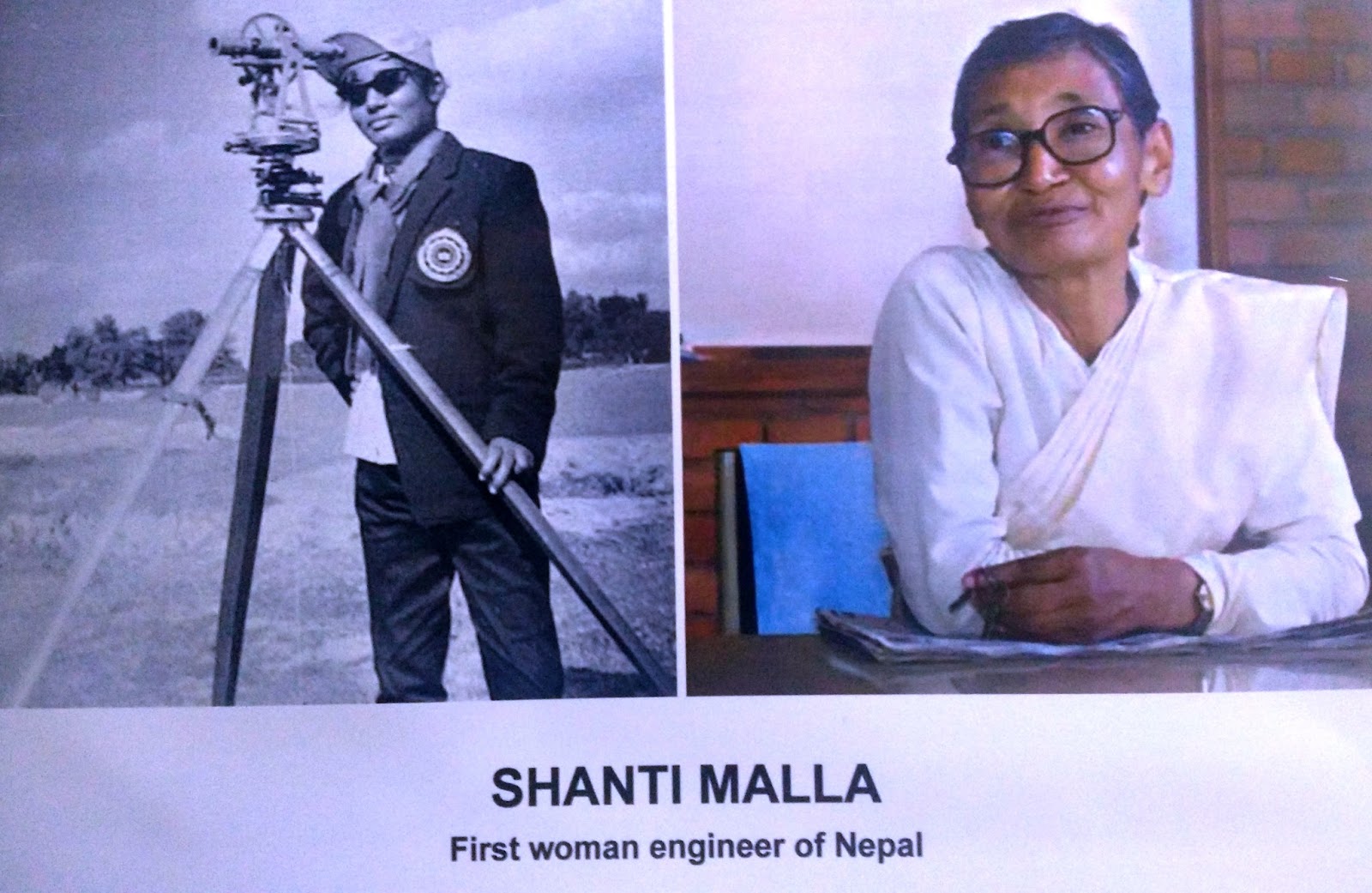
Int'l Women in Engineering Day celebrated in Nepal


Lalitpur, June 23: On the occasion of the International Women in Engineering Day, the Rural Access Programme (RAP3) – a joint project of the government and the United Kingdom’s Department for International Development (DFID) – organised a photo exhibition of women engineers in Nepal.
Organised at the Nepal Engineers’ Association (NEA) office at Pulchowk, the exhibition included photos and sayings of the Nepali women engineers from various fields such as computer, architect, civil and electronic.
One of the major attraction of the exhibition was the photo of the first women engineer of Nepal, Shanti Malla.
“We have tried to present their opinion on engineering field. This is the first time we are celebrating this Day in Nepal,” said Ayasta Pokharel, a graduate engineer at RAP3.
The exhibition showcased 40 photos of female engineers, their work and portraits. British ambassador to Nepal Richard Morris inaugurated the exhibition amidst a programme.
The International Women in Engineering Day takes place on 23 June annually.
This day is organised to cherish the achievements of women engineers and to draw attention of society on the careers in engineers and technical roles for women.
NEA and UK’s Institution of Civil Engineers (ICE) supported the programme.

AAC bricks launched


Kathmandu, June 23:
Chitwan based Aerobricks Company Friday launched Autoclaved Aerated Concrete (AAC) bricks in the market.
The brick is made of concrete, lime and iron dust and can be produced in a customized size through the automated machine.
“We have imported the German technology to produce the brick in Nepal. Although its known as ACC Blocks, it’s a brick and can be used as an alternative to the common bricks generally used in the nation,” said Babu Raja Rawal, executive director of the company.
The ACC bricks are about eight or nine times larger than the common bricks and therefore the construction work moves faster and needs less cement and sand, claimed the company.
The company was established with an investment of Rs. 500 million and employs more than 12 people since the plant is fully automated.
The plant has a capacity to produce 400 to 500 cubic metres of bricks per day.
“About 95 per cent of raw material used in the ACC brick is locally available materials,” said Rawal.
According to the company, the products are available in major cities across the country.


Friday, June 23, 2017

Govt. fails to activate Economic Rehabilitation Fund


Zero progress in supporting quake-affected industries

Kathmandu, June 22: The devastating Gorkha Earthquake of 2015 inflicted huge damage not only to the country’s physical infrastructure but also to its commerce and industry sector.
But there has been almost zero progress in supporting the industries and companies, and rehabilitating them even after more than two years and two months of the quake, although every budget since has included plans and programmes to help in their rescue and recovery.
The process to support the businessmen has been so slow that the government has even failed to activate the Economic Rehabilitation Fund (ERF) worth Rs. 100 billion, announced by then Minister for Finance Dr. Ram Sharan Mahat in the budget unveiled just a few months of the earthquake.
He had earmarked Rs. 5 billion to the fund.
The successive Finance Ministers Bishnu Prasad Poudel and Krishna Bahadur Mahara also included the ERF in their budget, but the fund has been lying idle, and promises of business recovery have been unmet.
The major stakeholders of the fund – Nepal Rastra Bank (NRB), Ministry of Industry (MoI) and the Federation of Nepalese Chambers of Commerce and Industry (FNCCI) – admit that efforts to activate the fund have been sluggish, and are unhappy about it.
The central bank had established the ERF through the Monetary Policy of s016/17.
“The government has already earmarked Rs. 5 billion for this fund, and 44 banks and financial institutions have expressed their commitment to deposit Rs. 29.59 billion as of mid-June 2016,” the monetary policy read.
The fund was supposed to provide credits of up to Rs. 100 million, extended in specified areas, at a subsidised interest rate of 4 per cent and 2 per cent on loans of more than Rs. 100 million during the first six months of 2015/16.
“Likewise, BFIs can extend loans to earthquake victims at a maximum 5 per cent interest for a specific business. The refinance facility can be availed from the fund at 1.5 per cent. Such facility will be provided on the entire loan amount of up to Rs. 50 million, and above this limit, the refinance facility will be provided only on 20 per cent of the excess credit limit,” said the policy.
NRB spokesperson Narayan Prasad Poudel said that progress to realise the Fund couldn’t pick up momentum as the process was initiated very late after formulating the manual and asking the banks to send data of the quake-affected business to the central bank.
The NRB had issued a circular to the BFIs on January 24, 2016 in line with the Economic Rehabilitation Fund (Establishment and Operation) Manual, 2015. The manual was approved by the government just a day before the issuance of the circular.
“It’s been only a couple of months since we have actually worked on the ERF. The NRB is analysing the data collected from the banks,” he said.
The NRB also said that the banks and financial institutions had not demanded any fund support for the quake-damaged industries.
Meanwhile, there are chances that the ERF will not be mobilised for some time in the future as the budget of the next fiscal year plans to merge it with other government-run funds.
“A study will be carried out to establish a strong and effective institution by merging funds like the Youth Self Employment Fund, Rural Self Reliance Fund, and Economic Revival Fund,” reads the budget of the fiscal year 2017/18.
The MoI and FNCCI said that both institutions did not have data of the damaged businesses.
“The private sector is not enthusiastic about the Fund since it involves a very complex process to obtain financial support. We had recommended to the government and NRB to simplify the process, but they didn’t incorporate our suggestions,” said senior vice-president of the FNCCI, Shekhar Golchha.
According to Purushottam Nepal, spokesperson of the MoI, the ministry is waiting for the guidelines document from the NRB, and the former has not received any complaints or applications from the businesses seeking rehabilitation.
Director of the FNCCI Meena Shrestha said that no data had been demanded from the business body by the ministry or the NRB so far.
The Post Disaster Needs Assessment (PDNA) conducted by the government in the immediate aftermath of the tremors had estimated that the business sector witnessed damage of more than Rs. 36.22 billion in the 14 severely hit districts alone.

Damage to the commercial sector was estimated at Rs. 16.95 billion and industrial sector at Rs. 19.27 billion. 

(Published in The Rising Nepal, 23 June, 2017)

Featured Story

Govt prepares primary draft of DRR Policy

Kathmandu, Apr. 29: The government has prepared the preliminary report of the National Disaster Risk Reduction (DRR) Policy and Strategic ...